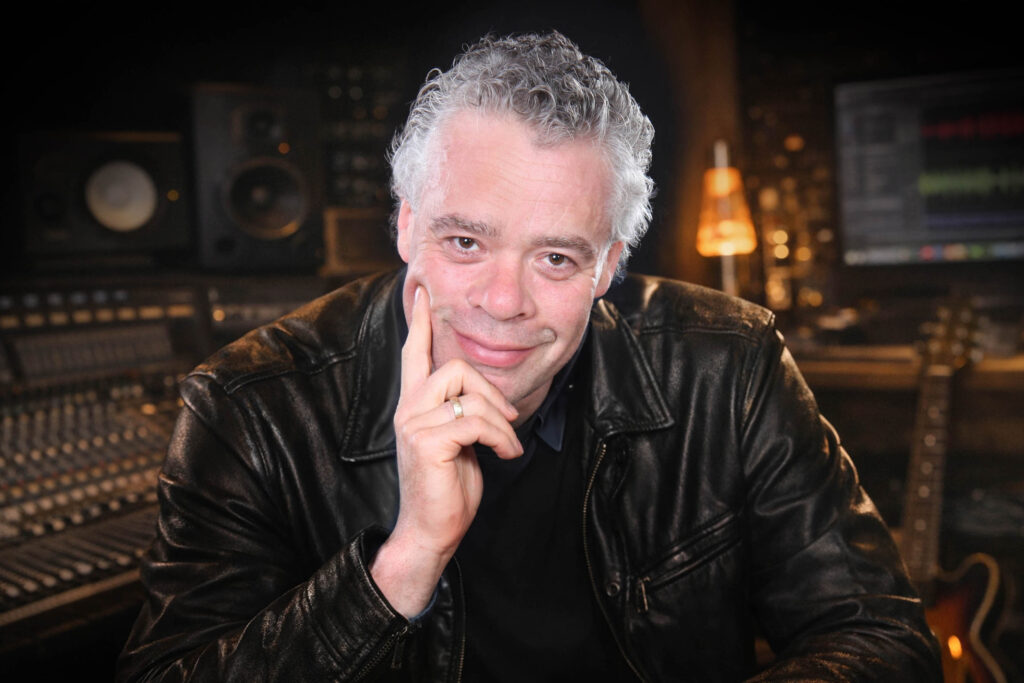
Who is Mekel Haunsby – also known as Mikkel Urup and “Miksky”?
If you’ve landed here because you probably searched for Mekel Haunsby or Mikkel Urup, you’re not actually looking at two different people…
“I was baptized Mikkel Urup, and that name is still my artist name in Denmark, where I live – and where many people first came to know my work as a photographer and artist. Later, I changed my legal name to Mekel Haunsby because it felt more fitting for an international career, and because “Urup” is often misheard outside Denmark. I coined “Haunsby” to travel better in sound and spelling, without losing the roots.”
One Year of Painting (Mikkel Urup)
A full-year overview of my painting production – presented under my artist name, Mikkel Urup.
So yes, there’s a split identity built into the story from the start….
And then there’s the bigger layer: the Haunsby voices. June, Dane, Nikki, Zaya, Luca – different temperaments and perspectives inside one coherent lyrical universe. If that sounds like a mystery, good. This article is where it gets unpacked.
Explore
- The Haunsby Family: Dane – June – Nikki – Zaya – Luca
- About Mekel: Mekel Haunsby
- Selected background work: Business Photography – Be Your Own Webmaster – Premium Domains – The Art of Writing – From Concept to Image
Q: When people land on this page, what do you want them to understand – fast?
Mekel: That this is human-led. The intention comes first. The lyrics come first. And the reason the output can look “bigger than one person” is because I’ve spent years building the skill of directing projects across mediums – film, photography, art, writing – and now I’m using modern tools to fill the gaps where I’m not a specialist.
This isn’t a “press a button” thing. It’s closer to producing a film: you need a vision, you need taste, and you need to know when something is good – and why.
Fairy Tale Clip (Featuring My Whistling)
A short storytelling piece – a fairy tale told in my voice, with plenty of whistling woven through the clip.
Q: You’ve talked about film as an early backbone. What did those years teach you?
Mekel: They taught me the price of production. In the early days, I could spend an enormous amount of time to make seconds of something look right. Rendering could be painfully slow. When you’re stacking layers – story, edit, effects, sound – you learn very quickly that technology can humble you when it doesn’t work optimally.
But you also learn the opposite: if you can keep going through that friction, you come out with a director’s mindset. You learn continuity. You learn character. You learn how to stay inside another person’s world long enough that the audience believes in it.
Nonames (Feature Film)
A long-form story project – written, directed, edited, and produced by Mekel.
Q: You pivoted hard into photography after film. Why?
Mekel: Because of time-to-quality. With photography, I could create something precise – fast. After an hour of photographing, I could polish it, deliver something I could stand behind artistically, and it would make a real person happy. That gave me an audience and an exchange that made sense. Film can be deeply satisfying, but it’s also expensive in time, money, and momentum.
Photography gave me a way to create at a high level within a realistic timeframe – and it trained my eye for quality control. That matters now more than ever.
Photography Showcase: A Broad Selection of My Work
A visual overview showing a lot of my work as a photographer – different moods, different people, and a wide range of portraits.
Q: So where does The Haunsby Family fit into that timeline?
Mekel: It’s basically my film mind, translated into music. I’ve always worked character-driven. I naturally see things from different perspectives, and I can keep a character coherent over time – temperament, moral logic, emotional gravity, development.
The Haunsby Family is that instinct, made audible. Albums and singles become chapters. The voices become viewpoints. The world becomes long-form storytelling.
Music Video – 100% Handmade (No AI)
I play every instrument, you can hear my actual voice, and I shot the visuals myself – fully analog craft from start to finish.
Q: You’re very specific about calling it AI-assisted. Why?
Mekel: Because it describes what actually happens. I can play instruments, but I have holes. I can hear things inside my head that I can’t always execute at the level I want – for example, I love blues, I can hear blues, I can write blues, but I don’t have the full ability to produce that sound world on my own.
And I tend to want to span the whole production: writing, sound, visuals, marketing, distribution. AI is strong at filling gaps. It steps in and says “I can handle that part,” again and again, so I can keep moving as producer and director instead of stopping at “I can’t.”
The tool does not replace taste. It accelerates the parts where I’d otherwise get stuck.
Building a Tiny House in 10 Days
A hands-on build project: turning raw materials into a cool hangout space for a teenager – fast, practical, and real.
Q: What will you not let the tools do?
Mekel: The core intention. The lyrical backbone. The direction of meaning.
I’ll use help like an advanced dictionary, a rhyme engine, a way to explore synonyms and angles fast – but the final line needs to feel like me. The text is the content. The intention. The moral architecture.
And I’m very aware of another issue: these systems also have filters that can misunderstand context. A single frame can get flagged even if the full narrative is completely normal and tasteful. Tools can struggle to judge the whole arc, so you learn to work around that without compromising the story.
Early Music Video – Directed, Edited & Produced
A past project for a music group that didn’t stay together – but the video still shows my editing ideas, pacing, and storyline work.
Q: You’ve mentioned “quality control” as the real job. What do you mean?
Mekel: Vision plus evaluation. You need a clear vision – and then you need to be able to hear/see whether each step moves toward it. That’s the producer role.
A beginner can like something without knowing why. A professional can explain why it works. That’s not arrogance – it’s the difference between taste and trained taste.
In this kind of production, the tool can generate options. But it can’t consistently judge itself at a high level. That’s still on me.
Learning Rumba in Spain (Documentary)
A personal documentary – two different instructors, two different approaches, one learning curve.
Q: Your background is wider than music: film, photography, fine art, writing, building platforms. How do you connect it all?
Mekel: It’s all the same craft: making meaning and making it land.
- Film taught me long-form storytelling and character continuity.
- Photography trained my eye for precision and delivery.
- Fine art gave me the patience for ambiguity and symbolic language.
- Writing taught me to build a world out of tone and rhythm.
- Building platforms taught me how to publish and structure the universe so people can actually explore it.
If you want to see the visual side of my work, start here: mikkelurup.com (and my Danish art hub is here: urup.dk).
Lecture: Influence & Control Tactics (So You Can Recognize Them)
A practical philosophy lecture on how control tactics work – shared so you can spot them when they’re being used on you.
Where to start in The Haunsby Family
Each voice is its own doorway:
Science Theory Lecture (Inductive vs. Deductive)
A documentary-style lecture on inductive and deductive reasoning – and what it takes to develop a science.
The creative foundation
At the foundation of the Haunsby Family is a single creative source.
All lyrics across all voices are written by Mekel Haunsby, who is also the creator of the overarching universe of the five different voices, which serve as channels for the lyrics, and the executive producer of the entire body of musical work. His role is not visible on the surface of the voices, but present in their coherence: the shared themes, the moral throughlines, the emotional architecture, and the long-form storytelling across albums and singles.
The Haunsby Family exists as many voices – but one authored world.
3000mm Zoom Test: Earth & Moon Are Spherical
A practical demonstration using extreme zoom – showing the curvature and spherical nature of both Earth and the Moon.
Read also
- “Miksky” – and the Haunsby Voices
- The Journey
- The art of being inspired
- Introducing RecallFit
- What about “past lives” or “reincarnation”?
Reflections (2001) – Art Film by Mikkel Urup & Mark Russell
An artistic cooperation between Australian violinist Mark Russell and Danish multi-artist Mikkel Urup – a drama excluding Man, a symphony of water.
This film is not a music video, nor is it a film with a soundtrack.
The music is made for the pictures, and the pictures are fitted around the music – audio and video integrated into an inseparable whole.
VizioNizer is an independent record label and creative universe built around one thing: lyrics that mean something. Lyrics that can stand on their own – but truly lift off when they’re given a voice, an arrangement, and a piece of music bold enough to carry them.
What does it mean when a lyric means something? It can be a relay of knowledge, philosophy, or a strong relatable story – or emotions that can tumble, or build a world.
The process begins: A concept appears – a feeling, a scene, a vision that refuses to let go. It turns into lines. The lines become a story. Then the story searches for its voice: the right presence, the right tone, the right kind of vulnerability or fire. From there we build the arrangement that can light the words up from the inside – rhythm, harmony, tension, release – until the lyric stops being text and becomes a living moment that needs expression.
Art Experiment (2001): Spoken Emotional Voices → Random Patterns
A strange little experiment from 2001 where I use spoken emotional voices to generate random patterns – part sound, part visual logic, part accident.
Production gives the story its body. Not as decoration, but as a channel – a contemporary, artistic form where the lyric writing can breathe, move, and hit the listener the way it was meant to.
VizioNizer releases do not start with genre. They start with intent. Genre is simply the costume the story wears.
This page is a guided tour through my creative work across film, photography, painting, lectures, and music – with embedded videos that show real output, not just claims.
You’ll see how my approach stays the same across mediums:
- I build from concept and story first
- I work obsessively until the result is good enough to stand by
- I care about meaning, not genre
- I prefer finished work over endless drafts
My First Reaction to Sora (Early 2024)
My immediate reaction when Sora first dropped – what it meant creatively, and why it felt like a real shift.
The AI part (because people are looking for that)
A lot of people arrive here with one core question: Is this AI Music, and if so – what part is actually you?
My answer is simple:
- Lyrics and intention are mine. That is the creative core.
- AI is used to fill gaps in execution and speed up production where traditional workflows would block the project.
- I use AI as a tool inside a producer mindset: I step forward as creator, step back as editor, and I do quality control continuously.
In practice, the workflow looks like this:
- A concept appears – a scene, a feeling, a line that won’t let go
- I write lyrics and shape the narrative
- The story “searches for its voice” – tone, vulnerability, fire, presence
- Arrangement and production are built to lift the words from the inside
- Final output gets edited like film: pacing, tension, release, coherence
AI can accelerate steps 3-4 massively, but it does not replace step 1-2. And it does not replace taste. If you can’t hear what’s good, you can’t steer the process.
Full Album: Canbaro – The Journey of the Apprentice
The complete Canbaro album in one continuous listen – built as a long-form journey rather than isolated tracks.
Production Notes: Making My Jazz Album “Canbaro”
My behind-the-scenes production notes from the process of making Canbaro – decisions, iterations, and what I listen for when shaping the final record.
Why this matters
Because the Haunsby project isn’t “AI music” as a gimmick. It’s a character-driven body of work, made possible by modern tools, but driven by old-school creative priorities: story, meaning, coherence, and craftsmanship.
If you’ve read this far, you’ve already seen the point: the work explains itself – across film, photography, art, and music – and the voices are simply the format I use to tell bigger stories.
More here.
How to Become a Good Photographer – Know Your Gear
In this video I talk about what actually makes someone a good photographer – and why knowing your gear deeply matters more than chasing new equipment.
